Mellan dans, vers & sång:
Svenska
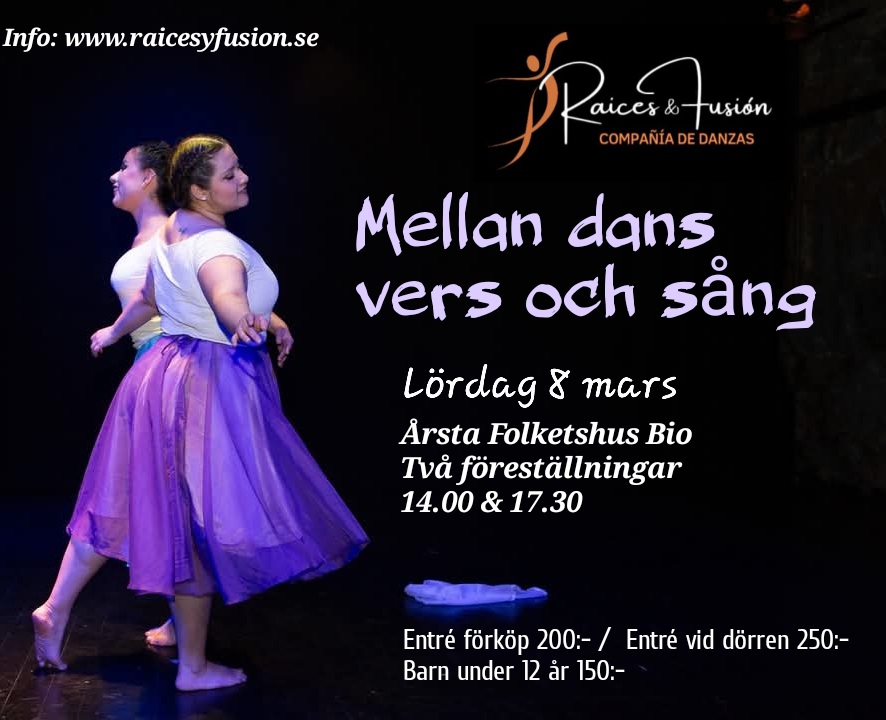
Mellan Dans, Vers & Sång är en scenisk föreställning som hyllar fyra betydelsefulla
sångerskor och kompositörer från Sydamerika: Chabuca Granda, Violeta Parra, Matilde
Casazola och Mercedes Sosa – alla centrala gestalter inom det latinamerikanska
kulturarvet.
Föreställningen är framtagen inför Internationella kvinnodagen och tar sin utgångspunkt i
kvinnors avgörande roll i samhällets sociala, kulturella och historiska utveckling, samt i det
pågående arbetet för jämställdhet. Genom dans, musik och sceniska tolkningar lyfts kvinnors
röster, skapande och motstånd fram – en historia som inte är fullständig utan deras bidrag.
De fyra konstnärerna representerar inte bara ett rikt konstnärligt arv, utan också en stark
social och kulturell påverkan vars verk fortsätter att inspirera över generations- och nationsgränser. Mellan Dans, Vers & Sång är en konstnärlig helhet där koreografi, rytm och
poesi samverkar för att hedra kvinnligt skapande, identitet och uttryck.
Chabuca Granda speglar i sina kompositioner ett nostalgiskt Peru och ett republikanskt
Lima, där valsen för oss genom Flor de la canela och Caballero de fina estampa. Hennes
verk rymmer även den afroperuanska kulturen, tolkad genom zamacueca och tondero, i en
hyllning till José Antonio.
Violeta Parra, chilensk kompositör och konstnär, kämpade mot orättvisor och för jämlikhet.
Hennes verk skildrar både personliga och kollektiva erfarenheter och utgör en grundpelare
inom den chilenska folkmusiken. Tolkningen följer hennes liv och skapande, och övergår i en
allegori över tiden då Chile berövades sin demokrati.
Matilde Casazola, boliviansk poet, författare och kompositör, skapade sin egen väg i ett
sexistiskt samhälle. Hennes texter präglas av upproriskhet och livskärlek, och tolkas genom
cueca, polka och aires de bailecito, där känslor som nostalgi, kärlek, besvikelse och glädje
får ta form.
Mercedes Sosa, den argentinska sångerskan känd som folkets röst, gav röst åt
Latinamerikas folk och deras berättelser. Under diktaturen förföljdes hon för sitt engagemang
för förändring. Föreställningen avslutas i hennes anda med en hyllning till Latinamerika
genom flaggor, Juana Azurduy de Padilla samt danser som huayno, zamba och chacarera.
Español
Mellan Dans, Vers & Sång es una propuesta escénica que rinde homenaje a cuatro
grandes cantautoras y compositoras de Sudamérica: Chabuca Granda, Violeta Parra,
Matilde Casazola y Mercedes Sosa, figuras fundamentales del patrimonio cultural
latinoamericano.
La obra se desarrolla en el marco de la conmemoración del Día Internacional de la Mujer
y parte del reconocimiento del rol fundamental de las mujeres en el desarrollo social, cultural
e histórico de las sociedades, así como del trabajo constante por la igualdad. A través de la
danza, la música y la interpretación escénica, se visibilizan las voces, el arte y la resistencia
femenina, una historia incompleta sin sus aportes.
Las cuatro artistas representan no solo un valioso legado artístico, sino también una
profunda influencia social y cultural que continúa inspirando a través de generaciones y
fronteras. Mellan Dans, Vers & Sång conforma una unidad artística donde la coreografía, el
ritmo y la poesía dialogan para honrar la creación, la identidad y la expresión femenina.
Chabuca Granda refleja en sus composiciones un Perú nostálgico y un Lima republicano,
donde el vals nos guía a través de Flor de la canela y Caballero de fina estampa. Su obra
integra también la cultura afroperuana, interpretada mediante la zamacueca y el tondero, en
homenaje a José Antonio.
Violeta Parra, compositora y artista chilena, luchó contra la injusticia y por la igualdad social.
Su obra retrata vivencias personales y colectivas y constituye un pilar de la música folclórica
chilena. La interpretación recorre su vida y creación, para luego transformarse en una
alegoría del período en que Chile fue privado de su democracia.
Matilde Casazola, poeta, escritora y compositora boliviana, forjó su propio camino en una
sociedad marcada por el machismo. Sus textos expresan rebeldía y amor por la vida, y son i nterpretados a través de cuecas, polcas y aires de bailecito, donde se manifiestan la
nostalgia, el amor, la desilusión y la alegría.
Mercedes Sosa, la cantante argentina conocida como la voz del pueblo, dio voz a las
luchas y relatos de América Latina. Perseguida durante la dictadura por su compromiso
social, la obra concluye en su espíritu con un homenaje al continente latinoamericano
mediante banderas, la figura de Juana Azurduy de Padilla y danzas como huayno, zamba y
chacarera.
English
Mellan Dans, Vers & Sång is a stage production that pays tribute to four influential singer-
songwriters and composers from South America: Chabuca Granda, Violeta Parra, Matilde
Casazola, and Mercedes Sosa — all key figures within Latin American cultural heritage.
The production is developed in connection with International Women’s Day and is
grounded in the recognition of women’s essential role in social, cultural, and historical
development, as well as the ongoing struggle for equality. Through dance, music, and scenic
interpretation, women’s voices, creativity, and resistance are brought to the forefront — a
history that remains incomplete without their contributions.
These four artists represent not only a rich artistic legacy but also a powerful social and
cultural influence that continues to inspire across generations and borders. Mellan Dans,
Vers & Sång forms an artistic whole where choreography, rhythm, and poetry come together
to honor female creation, identity, and expression.
Chabuca Granda reflects a nostalgic Peru and a republican Lima in her compositions, with
the waltz guiding us through Flor de la canela and Caballero de fina estampa. Her work also
embraces Afro-Peruvian culture, interpreted through zamacueca and tondero, in tribute to
José Antonio.
Violeta Parra, a Chilean composer and artist, fought against injustice and for social equality.
Her work portrays both personal and collective experiences and stands as a cornerstone of
Chilean folk music. The interpretation follows her life and creative journey, later transforming
into an allegory of the period when Chile was stripped of its democracy.
Matilde Casazola, a Bolivian poet, writer, and composer, forged her own path within a
patriarchal society. Her texts convey rebellion and a deep love of life, interpreted through
cueca, polka, and aires de bailecito, expressing emotions such as nostalgia, love,
disappointment, and joy.
Mercedes Sosa, the Argentine singer known as the voice of the people, gave voice to the
struggles and stories of Latin America. Persecuted during the dictatorship for her social
commitment, the production concludes in her spirit with a tribute to Latin America through
flags, the figure of Juana Azurduy de Padilla, and dances such as huayno, zamba, and
chacarera.